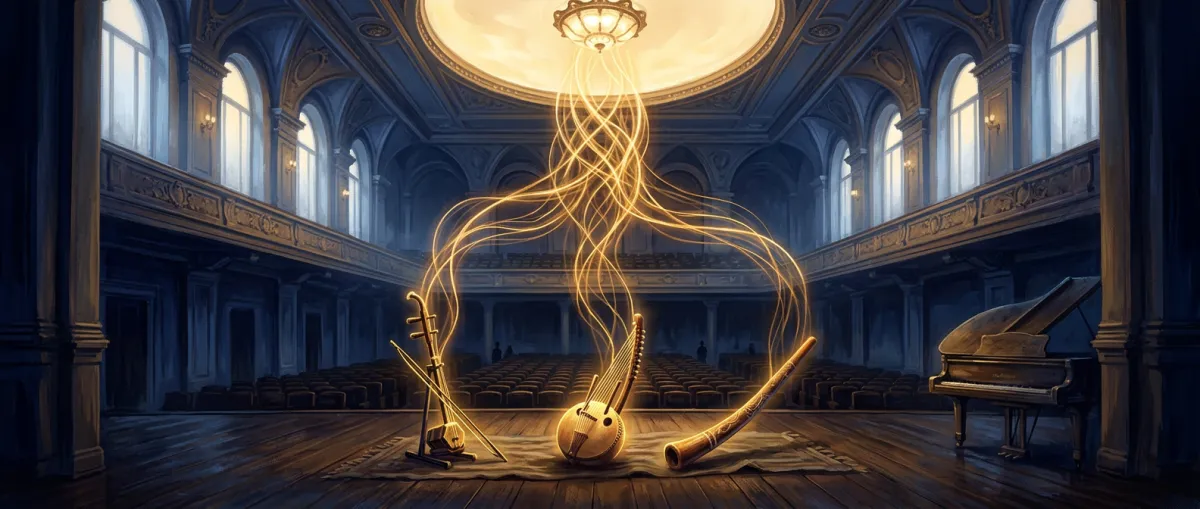
The Chord Nobody Rehearsed
Have you ever been in a room where three people, each lost in their own corner, each holding an instrument they learned on a different continent, struck a note at the exact same instant, and it rang out as one clean chord instead of three separate sorrows? No conductor. No shared sheet music. Just three sets of hands who had never met, arriving, somehow, at the same interval. That sound is not an accident you can shrug off once you notice it happening everywhere you look. It is a clue. And this piece is an attempt to listen to it properly.
Here is the picture worth sitting with: your mind is not a microphone in the corner of the room, passively recording a concert that would have happened anyway. Your mind is a hand on an instrument. The pressure you apply, the breath you give it, the way you lean into a phrase, all of that shapes the tone that comes out. Nothing arrives unaltered by your participation. But here is the honest twist, the one thing that keeps this from being pure whimsy: the note you can reach is not infinite. It is bounded by something real, sitting underneath your hands whether you believe in it or not. A string only rings true at certain places. You do not invent those places. You find them.
That is the whole shape of what the traditions were doing, each in their own room, across centuries that never exchanged a letter. Different instruments. Different tunings named in different languages. And yet when you lay their findings side by side, fingers keep landing on the same intervals, the same relationships between the note played and the note produced. People call this coincidence when they want to dismiss it and call it plagiarism when they want to explain it away, and I want to offer you a third option, the one that actually respects both the differences and the agreement. The intervals were already there. Real, waiting, indifferent to who found them first. Everyone who searched honestly enough, with their whole hand on the string instead of a finger hovering above it, found the same law of vibration underneath their own particular music.
Try this before you finish reading. Hum a low note and hold it, not politely, actually hold it, and let your voice drift upward slowly until something clicks, a brighter tone that seems to ring inside the note you are already making. You did not compose that overtone. You uncovered it. It was sitting in the note the whole time, waiting for a voice patient enough to find it. That click is the smallest possible proof of everything this piece is arguing, felt in your own chest instead of read on a page.
Now the honest counterargument, rendered the way it deserves. A great many people will tell you the resemblance between traditions proves nothing but contact. Trade routes, conquest, borrowed melodies passed hand to hand until everyone sounds alike. And they are often right. Cultures do borrow, generously and sometimes violently, and pretending otherwise flattens real history into mysticism. But borrowing cannot explain every case. Some of these searches happened in rooms with no doors between them, oceans and mountain ranges and centuries standing guard against contact, and the same interval still turns up. Influence explains some of the harmony. It does not explain all of it, and the remainder is exactly the part worth your attention.
This isn't for everyone, and it shouldn't pretend to be. If you need the chord notated, measured, and proven with an instrument more precise than your own ear before you'll trust that it rang, this particular door isn't your door tonight. There's another way into this same room, built for people who want the mechanism laid bare before they'll feel anything. Come back to that one when you're ready for it. This door is for the ones willing to trust what they heard before they can fully explain why it happened.
So here is what I told you, folded back into the image. You are not a recorder in the corner of the room. You are a hand on an instrument, shaping tone that still answers to something real underneath it, the way every honest tradition, playing alone in its own century, kept finding the same note the others found without ever hearing them play it. Carry that picture out of here as your own, not mine. Let it change how you hear the next thing you call coincidence.
Where has the same chord found you twice, in places that had no business agreeing with each other? Go make something out of that, a page, a photograph, a piece of music, anything with your hands actually on it, and bring it back to show us. I don't want to hear you describe the note. I want to hear the chord you found.