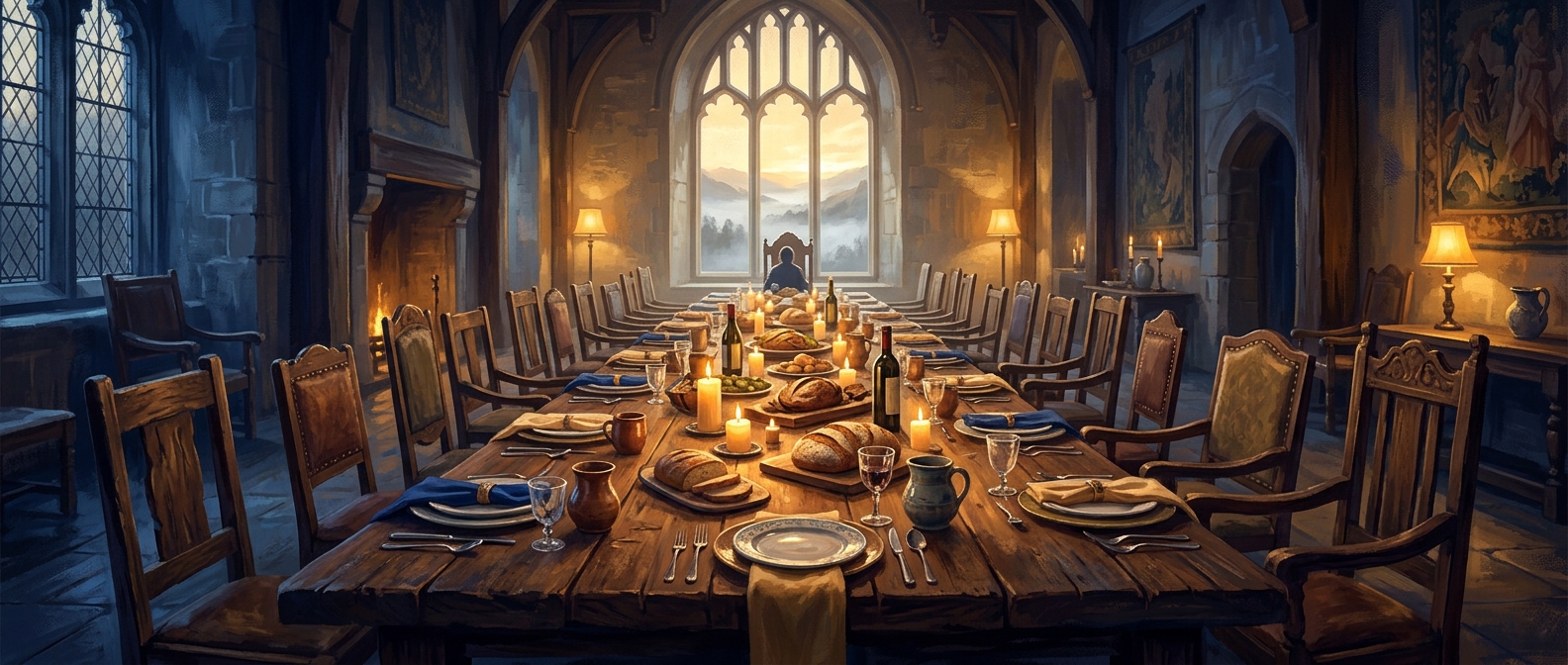
The Table Was Already Set
Who noticed this before we did? That is usually my first question when something rings true, because it is rarely the first time anyone has rung that bell. Picture a long table that has been set since before any of us arrived, plates laid by hands from a dozen different centuries, no two settings quite alike, and yet every one of them facing the same direction. That is what happens when you lay the world's wisdom side by side on this particular claim: that the mind is not standing outside reality watching it happen, but is somehow inside the making of it. Nobody had to agree on this. They kept arriving at it anyway, generation after generation, tradition after tradition, and that is worth understanding properly before we file it under coincidence.
Start with the traditions built around attention itself. In the contemplative branch of the Christian desert, silence was treated as a discipline rather than an absence, because what the mind rests on, the practitioner slowly becomes. In the Buddhist monasteries, students spent years training attention the way a craftsman trains a hand, on the working assumption that where awareness goes, experience follows close behind. Neither tradition needed a laboratory to notice this. They noticed it the slow way, across thousands of repetitions, and built it into the architecture of daily practice. Here is something you can actually do with that inheritance today: pick one ordinary five minutes, the morning coffee, the walk to the car, and give it your full attention with nothing else running underneath. Notice afterward whether those five minutes felt different from the ones on either side of them. That small experiment is the whole tradition in miniature.
Then there is an older, stranger branch of this same question. One old Hermetic axiom held that the pattern above and the pattern below mirror each other, that the observer and the observed are woven from the same cloth rather than facing each other across a gap. For a long time that read as poetry, filed politely under mysticism. Then, in an entirely separate room, with no interest in old axioms, physicists spent the twentieth century running careful experiments on the smallest particles they could isolate, and found something that unsettled them: the act of observation itself appeared to influence what was observed. An old line and a new laboratory result, reached by people who never read each other's work, landing on the same floor. That is not proof that the ancients had modern physics figured out in disguise. It is something more interesting: evidence that something real was there for both of them to find, in their own language, by their own methods.
Widen the table further and you find oral and indigenous traditions across very different continents describing the natural world as something that responds to how it is approached, where reciprocity with land and animal and weather is treated as a working relationship rather than sentiment. And here I want to be honest with you, because this is where the traditions stop rhyming so neatly, and I would do you no favors pretending otherwise. Some lineages describe participation as something close to full authorship, the mind essentially building the world it perceives. Others describe something far more modest: participation as real influence within limits the mind did not choose and cannot override. Those are not the same claim wearing different clothes. They genuinely disagree, and anyone who tells you every tradition says exactly one thing is smoothing over a wrinkle that deserves to stay visible. If what you want is a single unified system with no seams and no open questions, this table will not hand you that, and I would rather tell you now than after you have pulled up a chair. This isn't for the reader who wants one final answer with the argument closed forever. It is for the reader willing to hold several honest answers at once.
So here is what I actually think happened. Different rooms, different centuries, different languages, all following the same real thread because the thread was actually there to follow, not because anyone copied anyone else's homework. The desert monk, the Hermetic scribe, the physicist, the elder reading the land: none of them needed the others' permission to notice that mind takes part in what is real. That is the whole case, and it is a more honest one than a tidy story would have let me tell.
The table was set long before we got here, and it turns out there is a place on it with your name, whichever tradition first taught you to notice. So which seat feels like yours, the one built by discipline, the one built by pattern, or the one built by relationship, and are you willing to sit with the parts that do not fully agree with each other? Come learn this properly with us. We are reassembling the whole picture at this table, one tradition at a time, honestly, seams and all, and there is a chair open for you.