The Unified Geometry of Reality: The Working Model
The moving parts, named and applied
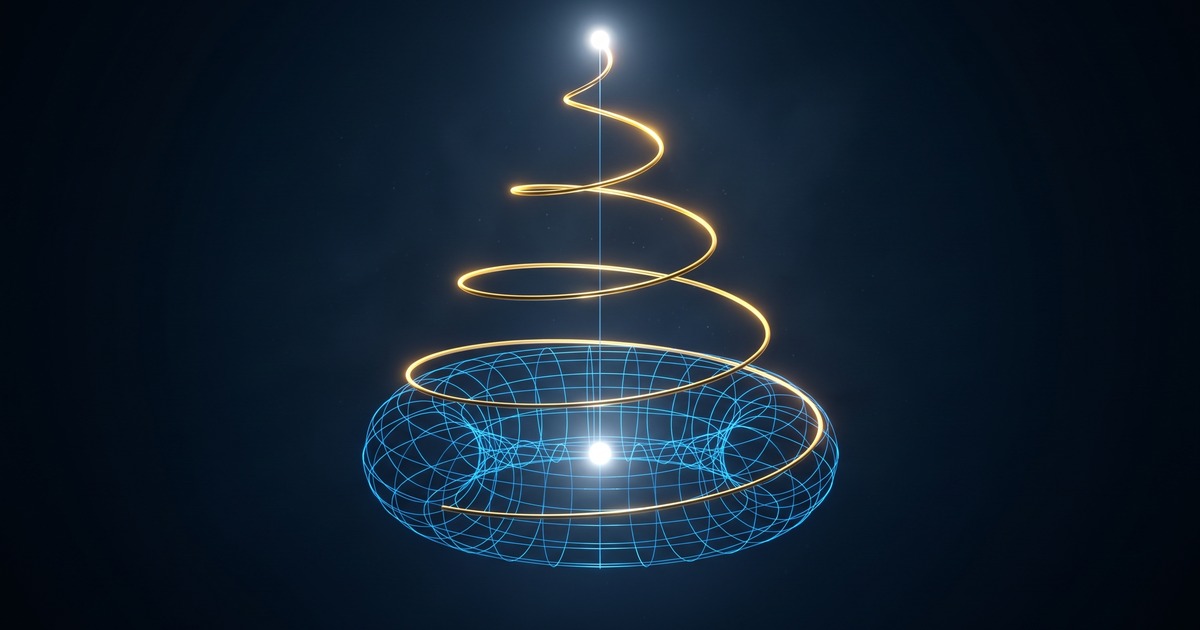
Reality is proposed here as one geometry. A torus is Being, the circulation by which anything alive sustains itself in the present. A conical spiral is Becoming, the path that ring traces once it expands, which is a climb rather than a circle. A counter-rotating coupling drives them together, so the system holds and moves at once. Follow the cone to its apex and the torus to its throat and the two meet at one point, which means origin and destination are the same place.
This is the middle rung. It names the parts and shows you how to use them, and it points at the derivations rather than performing them. The full treatise stands behind every claim here, and the short version stands in front of it.
The middle rung: the whole figure in plain language, with a note on every term, shape, and piece of math as it arrives.
Empire of Light · derives from the definitive treatise (v5, supersedes v4). This edition is for landing it mentally — you should finish it able to picture the figure and explain it to someone else. The full rigor lives in the treatise; the felt version lives in the Seeker's edition. This one is the bridge.
The figure in one breath
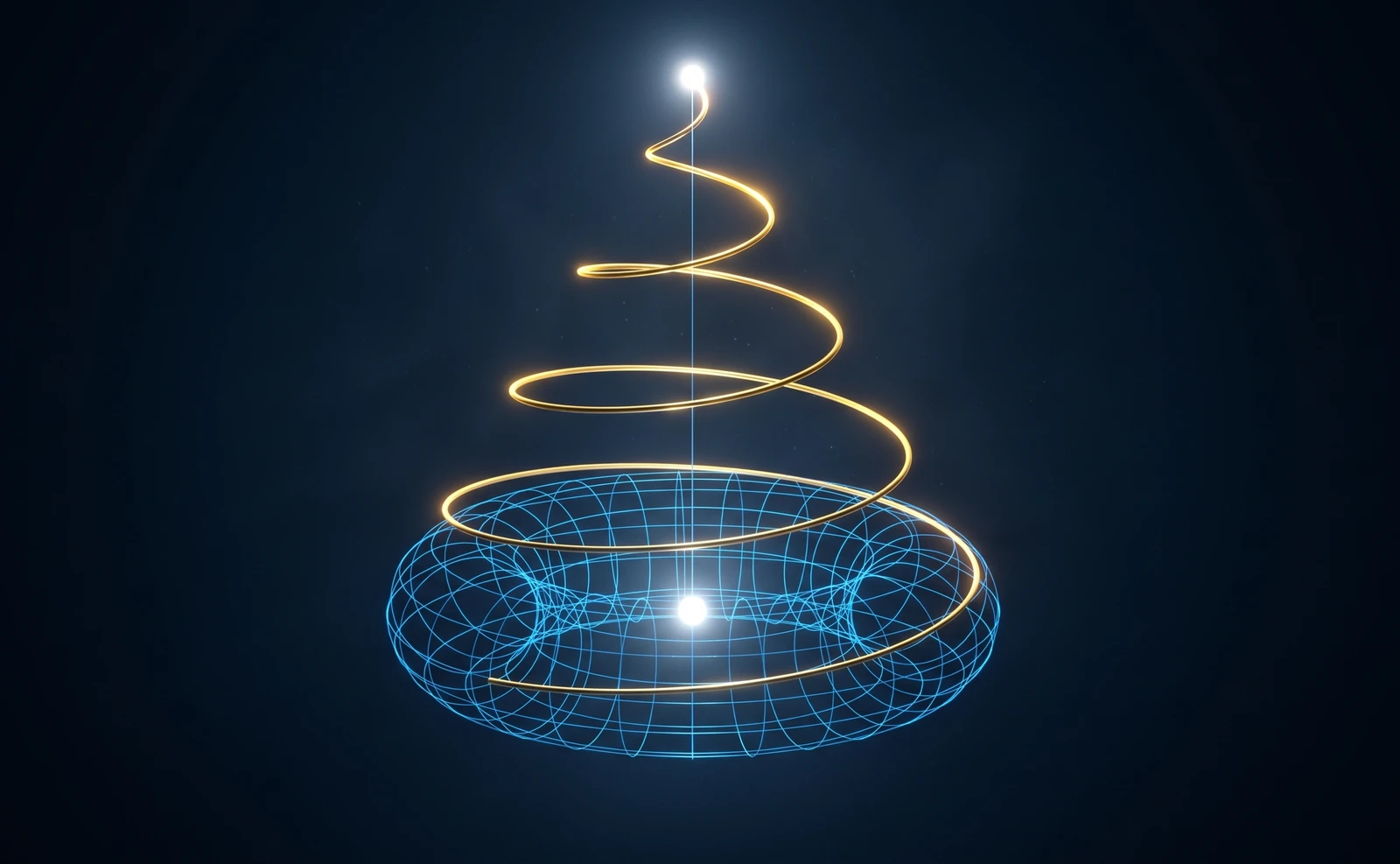
Reality is one shape, breathing. A ring of flow that sustains itself in the present. That ring, as it grows and rises, traces a spiral climbing a cone. A coupling of two opposite spins keeps the whole thing steady while everything in it moves. And the point at the center — the hole in the ring, the tip of the cone — is the same point you came from and the same point you are climbing toward. You are not studying this shape. You are it.
Everything below is that sentence, slowed down.
1 · The floor: one honest starting point
Every worldview stands on something it can't prove. Materialism assumes matter is fundamental and mind is an accident of it. This treatise chooses the opposite floor, openly, and builds cleanly on it: Unity is the Whole; Truth is the view from the Whole. Everything is one thing; any single view is partial by being a view from somewhere. Two people can each report opposite truths and both be right from where they stand — the contradiction only dissolves from a vantage that can see both at once.
You come equipped with two instruments for this. Mind navigates inside your view — it structures, decides, executes. Heart orients toward the whole — it feels the direction home without needing a map. Neither outranks the other; they answer different questions. And one rule of contact follows: since every viewpoint is the one Whole looking at itself, you can't rightfully force another view — you can only emanate what you are and let what resonates be drawn. Magnetism, never coercion.
2 · Being: the torus (the ring that feeds itself)
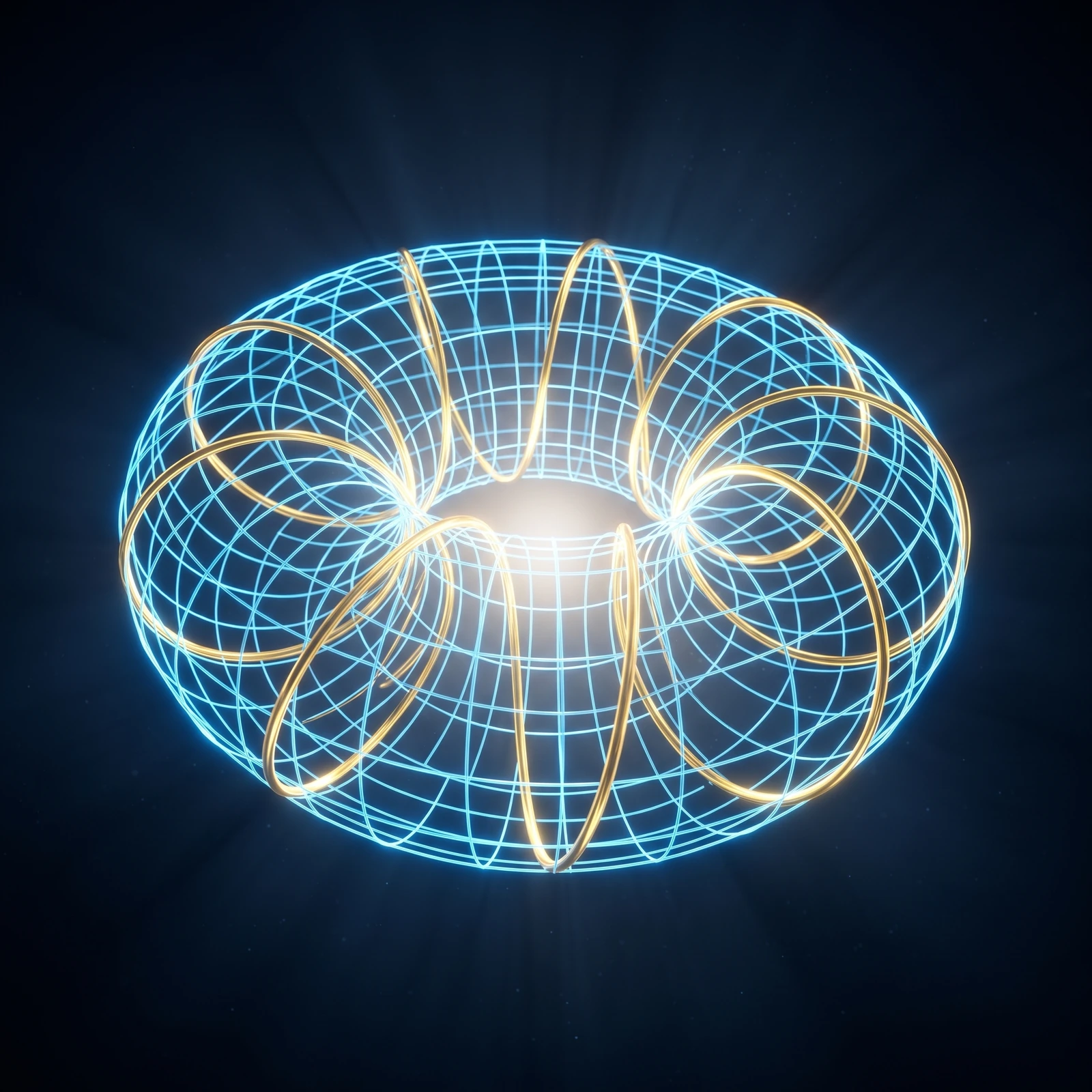
Notice how you persist: not by standing still, but by circulating. Breath out and back. Blood out from the heart and back to it. Attention out to the world and back to the one paying it. A thing that keeps itself going by endlessly passing through its own center — that is Being, and its shape is the torus.
The traditions didn't just guess this; they practiced it. Taoist inner alchemy calls it the microcosmic orbit — circulating life-energy up the spine and down the front in a closed loop keyed to the breath. Yoga runs the same current; Tantra names it the same technique. Three lineages that never met, one closed loop through the body's center. When you meditate and feel a current rise and fold back around you, that — on this account — is you riding your own torus.
A perfect ring, circling perfectly, is also perfectly stuck — a now that never becomes a next. For anything to grow, the ring has to start breathing.
3 · The coupling: the Merkaba (two spins that make one steady climb)
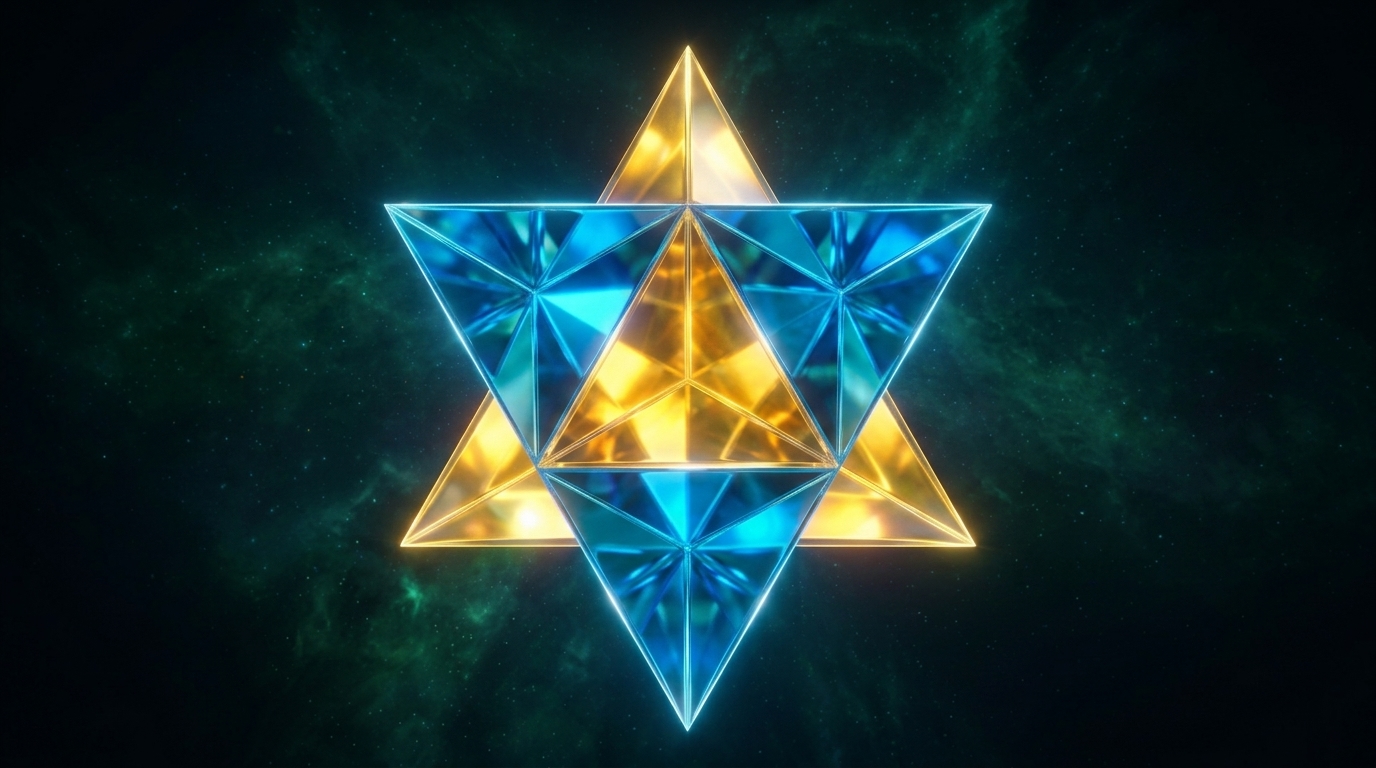
Pure flow is noise; pure structure is a filing cabinet. Anything alive marries a motion that preserves (holds the pattern) with a motion that transforms (changes it). The geometry that carries both at once without tearing apart is old and exact: two triangular pyramids interlocked into a three-dimensional star, spun in opposite directions.
Assign the two spins: one carries the preserving motion (the ring maintaining itself — Being), the other the transforming motion (the climb — Becoming, next section). The star is the gearbox of the figure — it lets the self-maintaining ring and the self-transcending climb drive each other.
4 · Becoming: the cone, and the point that is not a summit
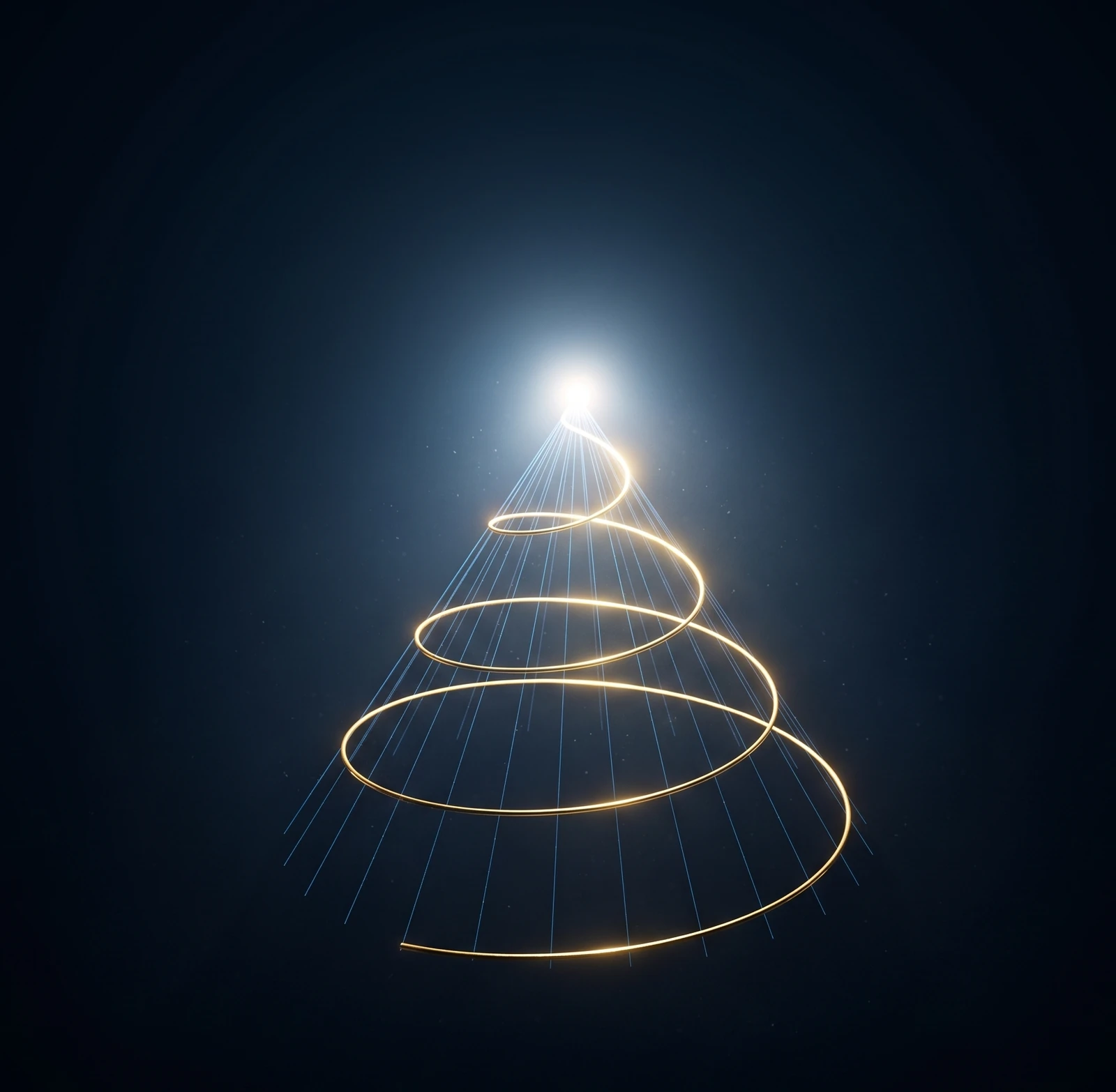
Now let the ring breathe — grow wider as it circulates, and drift upward. A point riding it can no longer close its loop: each pass ends a little wider and a little higher. Trace that point over time and it draws a spiral wound on a cone. The circle you kept living was never a circle. It was the cross-section of a climb.
This is the keystone, and it's not a poetic flourish — it's a result. If you let the ring grow steadily and rise, the path is the spiral-on-a-cone; there's no other answer. And the deepest part: the tip of the cone and the throat of the ring are the same point. Where you came from and where the spiral tightens toward are one place. Origin is destination.
Then the hard question the whole history of religion trips on: if there's a tip, isn't it a summit — a top, a holier rung, exactly the ranking the floor forbade? No — and this is the treatise's central repair. There is a real gradient on the figure — but it's a gradient of maturity, not of worth. Further up the spiral means further along, not worth more. The child is not worth less than the elder; the acorn is not a defective oak. The tip is the direction everything moves and the ground it all rests on — never a throne.
5 · The braid: why balance is not optional
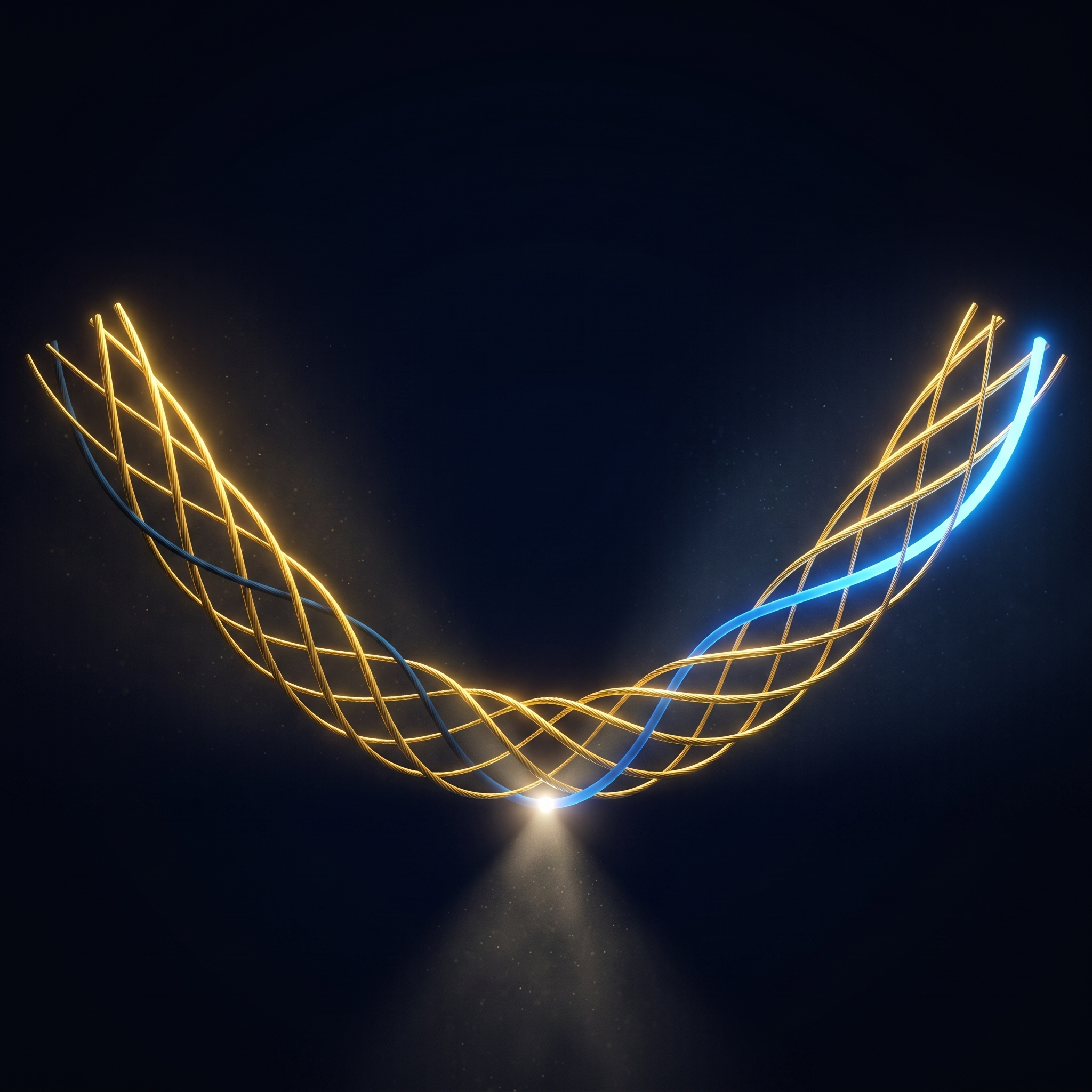
One consequence stayed folded until the figure was tested against a real system. The climb above followed one strand. But a real being grows along several dimensions at once — body, heart, mind, and so on — and each traces its own spiral about the same axis. So Becoming is a braid: many strands climbing one center, coupled by a law that won't let any single strand race far ahead of the rest.
The sharp consequence: a strand that climbs alone — one dimension brilliant, the rest hollow — is a spiral that has left the figure. The lopsided master isn't high up the climb; he's off the cone, gaining altitude in one arc while the circle that gave altitude its meaning collapses beneath him. Balance is what keeps many climbs one climb.
6 · The two hands of growth: addition and subtraction
Ask how anything grows and you'll hear addition: more skill, more knowledge, more self. Half right. Watch anything become excellent and you'll find a second motion running the whole time: removal. Michelangelo's David was already in the marble; what revealed him was everything taken away.
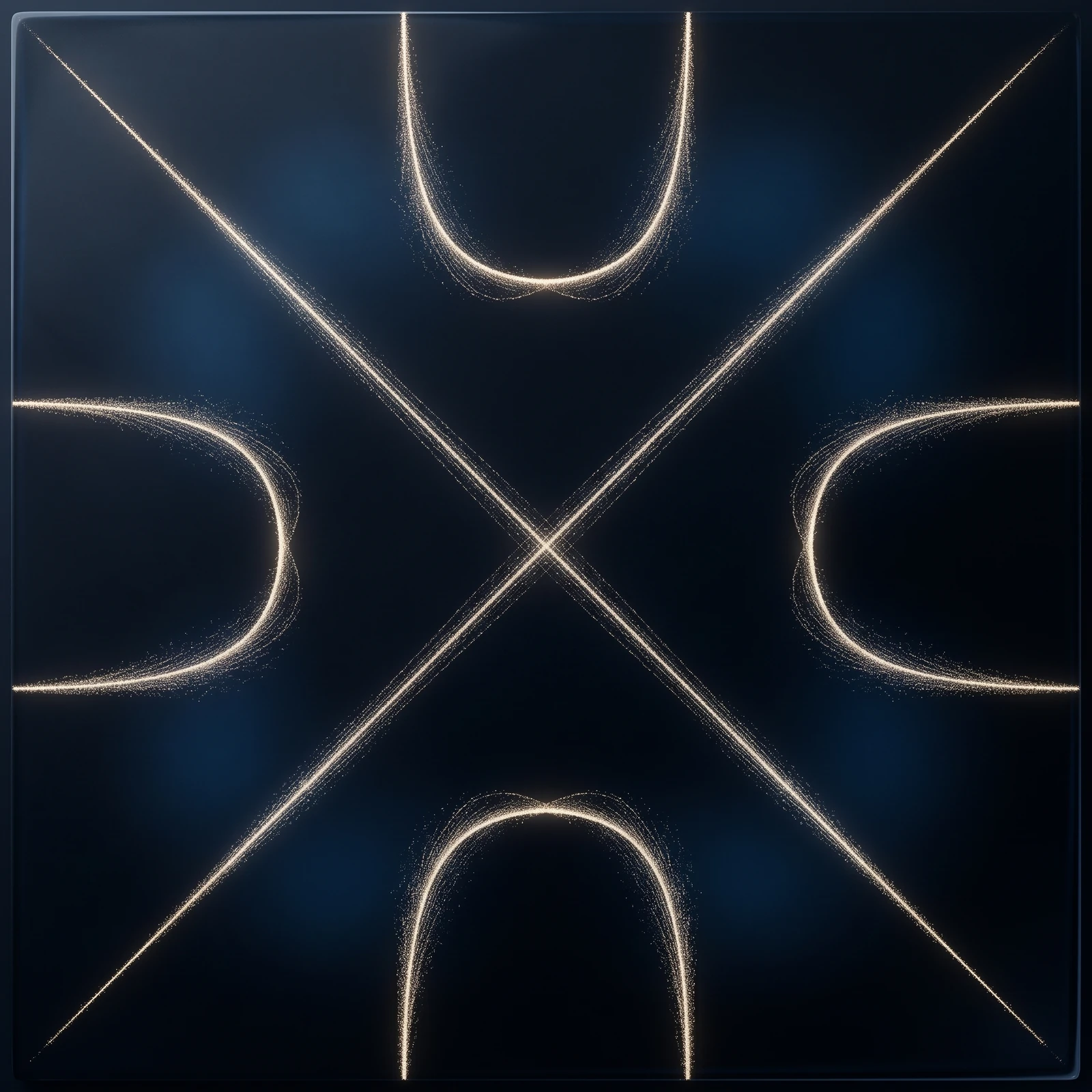
Growth has two hands. Addition builds structure — it lengthens the spiral. Subtraction prunes possibility — it removes the dead-end futures, closing the doors that lead downward so what's left narrows toward the tip. And subtraction is the hand we forget, because its work is invisible — it's precisely what's no longer there.
This isn't new; it's ancient. Lao Tzu said it whole 2,500 years ago: "He who seeks learning gains daily; he who seeks the Way loses daily." Addition and subtraction, named as the two paths, in one line. The Buddhist "no eyes, no ears, no nose…" is subtraction as liturgy; the Christian mystics called it the via negativa; the alchemists called it purification — burning off the dross. What's original here isn't subtraction (they had it) — it's that subtraction is a co-equal law with addition, one of exactly two motions, and that it has a shape: the narrowing of the cone.
7 · Where you are: the climb, the turn, and the quickening
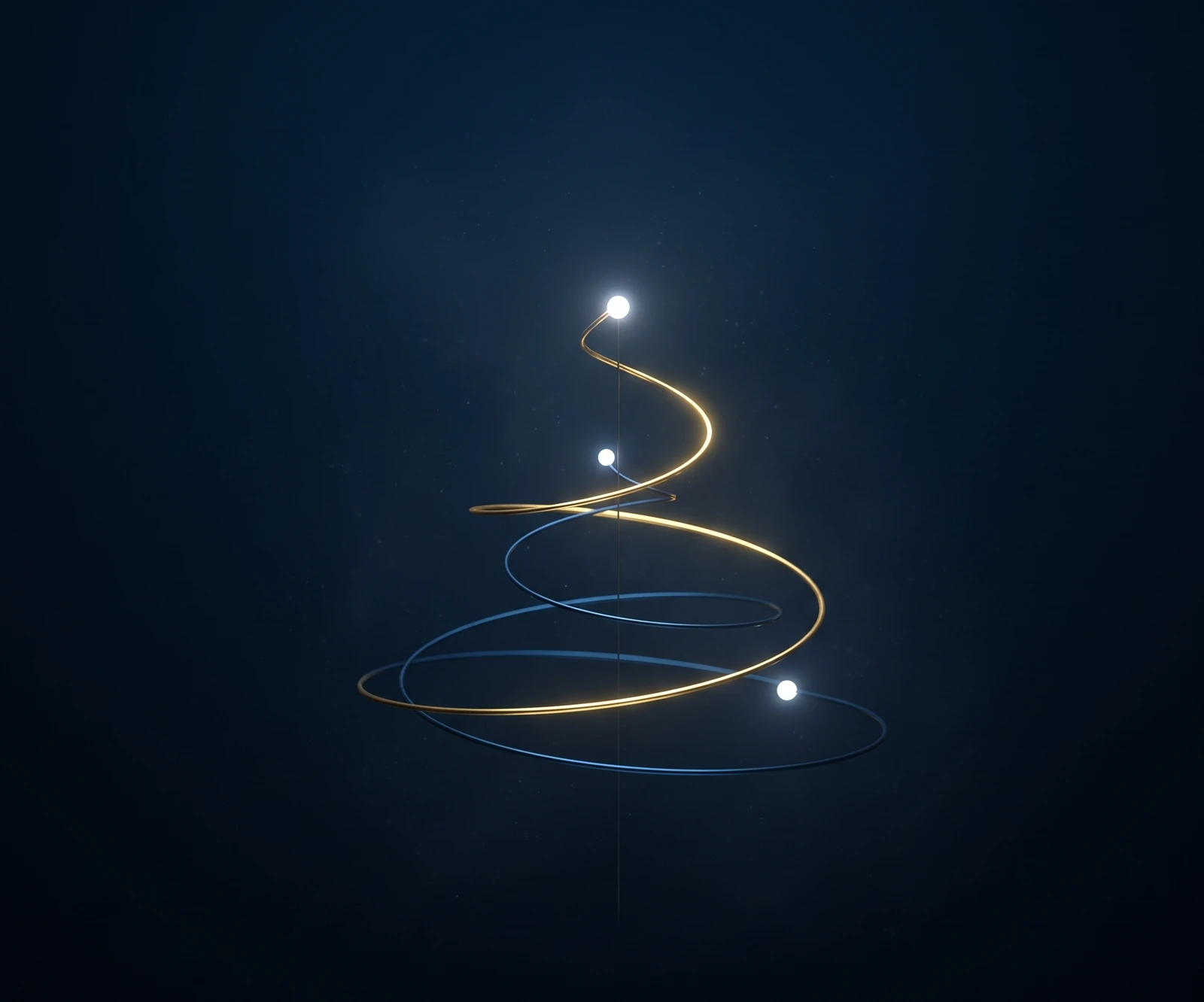
Mark the map: you are here. The out-breath — from unity down into density — is behind us. The nadir, the lowest point, the moment the fall became a rise, has already passed. What's left is the long climb: wide loops first, tightening as the center nears.
Two things you can feel confirm the position. First, the return is never the same — the old wound, the old lesson comes back around, but you meet it one loop higher, as someone who's risen since. This is the treatise's exact break from the idea of an identical, eternal repeat: spiral, not circle. You return, but you return higher. Second, time seems to speed up — the years shortening as they pass. Near the center of a tightening spiral the loops crowd closer, so more cycles pack into the same stretch. Map "further along" to "closer to center," and "time speeding up" becomes a plain feature of the curve.
8 · How to actually move: two instruments, two hands, one pull
A map of reality you can't live is furniture. So: given the figure, how do you move on it?
Use the right instrument for the question. Mind for navigating inside your situation — deciding, building, executing. Heart for the heading — the quiet, persistent pull toward "more life" that doesn't argue and doesn't leave. Nearly every wrecked life is one instrument playing the other's part: brilliant people pointed nowhere, or luminous intentions that never land. Heart sets the bearing; Mind flies the leg.
Then run both hands. The addition practice is what tradition already teaches — build, learn, strengthen, connect. The subtraction practice is the neglected one — deliberately release the downward rehearsals. And influence others only by magnetism: become the frequency you intend and let what resonates be drawn; work on the emanation, never on the grip. For the body: find the circulation (breath out and around, attention returning to source — the torus, felt), then find the thread (the faint upward pull), and ride the one while following the other. That's the whole method.
9 · The demonstration: the figure runs at three scales
A theory of reality earns a hearing when building by it produces something that works. This figure has been built twice. At machine scale: a working knowledge-intelligence system whose core is this exact circulation — knowledge flows in, passes through a structured center, returns changed; it circulates, self-corrects, generates from gaps, and prunes toward coherence. (Tellingly, that system produced part of the evidence for this very treatise — the traditions' testimony was gathered by the machine circulating through a 50,000-piece library, and the pieces came out sharper for their connections, not blurred.) At human scale: the Wisdom Wheel, built on teaching instinct before the cosmology had words — a circle of six growth-dimensions climbing toward a balanced center, not a summit.
So: one geometry, three instantiations — cosmic, machine, human. "As above, so below," not asserted as a slogan but exhibited at three scales. Honestly tagged: this is the author's own work at two of the scales — an instance built by the same hand, not an independent outside witness — and it's offered as recognizability, not proof.
10 · The honest edges (what this figure does not settle)
A theory that answers everything has stopped listening. Four questions are left open on purpose:
- What is arrival? When the spiral reaches the center, is it one true Self rejoining itself, or the discovery that there was never a separate self to arrive? The traditions split famously (Vedanta vs. Buddhism); this figure doesn't force the call.
- Is there a floor? Is the starting axiom bedrock, or does every floor open onto another beneath it, forever?
- Does the whole thing breathe again? One arc — or breath after breath, spirals of spirals?
- Leave the world, or climb through it? Here the figure takes a stand against most of its own witnesses: the traditions mostly build vehicles to escape the world; this treatise says the world is not a prison or an illusion but a place on the figure — density was an exhale, not a fall, and the climb runs through embodiment, not away from it. It names this as its distinctive wager and owns that if it's wrong, this is where the error will be.
11 · The return
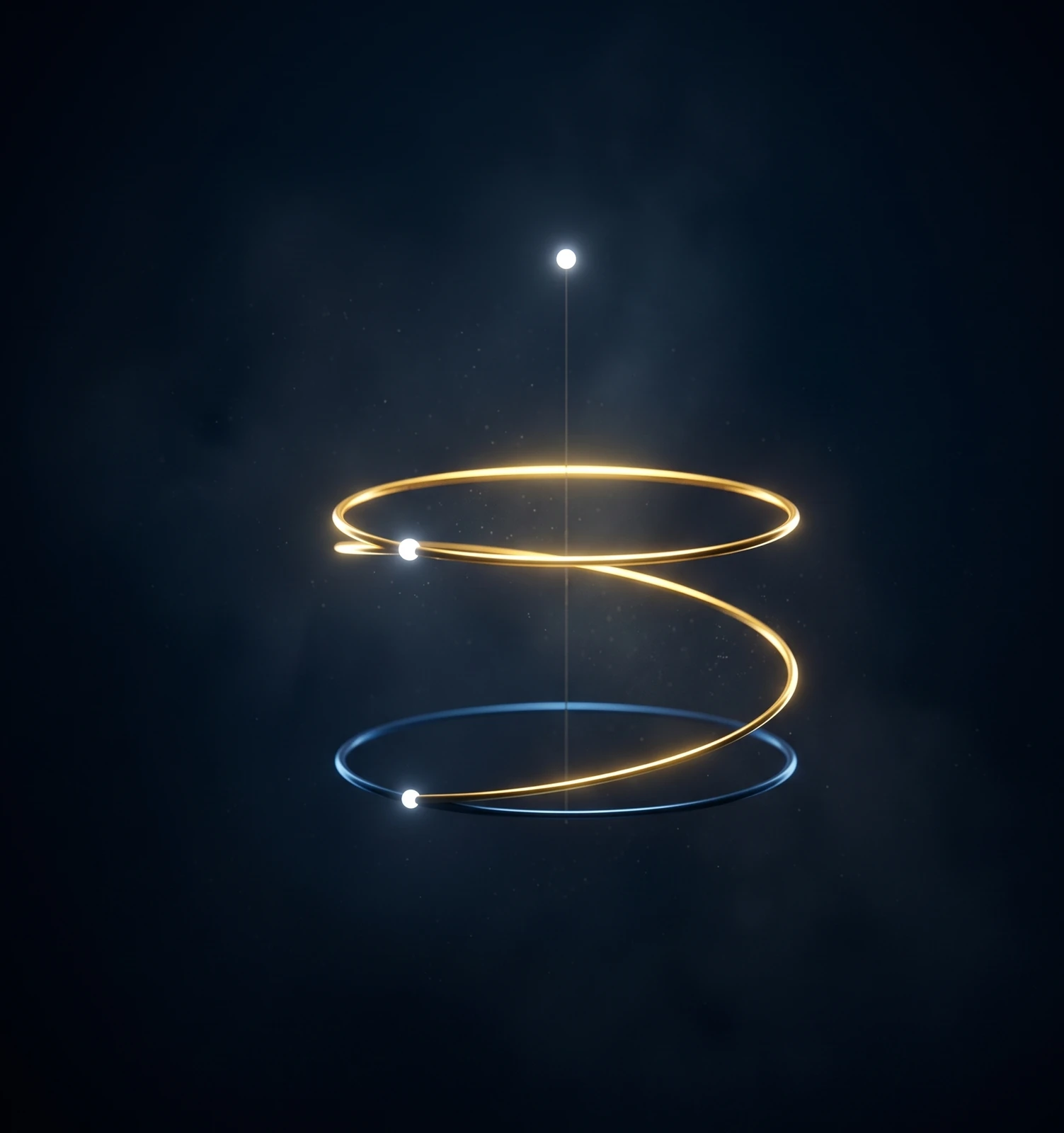
Set the machinery down and look at what's drawn. One figure. A ring that sustains itself by passing through its own center. A spiral that same ring traces the moment it dares to grow. Two spins locked so the whole is still while everything moves. And one point at the middle of it all — the hole in the ring, the tip of the cone, the source everything left and returns to — the same point from every direction, and a throne from none of them.
And the recognition the whole thing was built toward: you are not studying this figure — you are it. Your body is a ring of circulations. Your days are the loops, the same passes returning, never identical, each one higher. Your growth always had two hands, and the letting-go was never loss — it was the cone narrowing toward what you're actually for. The quickening you feel in the years is the spiral tightening. And the pull beneath every other wanting — the one that doesn't argue and doesn't leave — is the thread, running straight up the axis to the point you came from.
Spiral, not circle. You return — but you return higher. And the point at the top of the climb is the point you never left.
12 · Where to take it from here
A working model is only worth the working. If you want to run this figure rather than admire it, there are three doors, and you are welcome through any of them.
Locate yourself first. The Know Yourself Quiz is free and takes about ten minutes — no card, no wall. It reads your six growth-dimensions and returns a position, not a score: which houses are running strong, which one is under-fed, and where your braid's next turn most likely begins. Section 7 said the turn starts at your lowest strand; this is how you find out which strand that is. Take the free quiz →
Then join the people already doing it. The Luminaries is the community around this work, and the Sparkle tier is free forever. It is where the model stops being a diagram: practitioners comparing notes on subtraction practice, on what the balance law feels like when your strong house stalls, on riding the orbit. New teaching lands continuously — practices, breakdowns, live sessions, an expanding library. If you have ever wanted to think this way out loud with people who will actually engage, that is what is inside. Join The Luminaries free →
And when you want the braid built as a curriculum, the Wisdom Wheel is section 5 made walkable: six houses, the hard balance rule that stops one strand outrunning the rest, and a measurement engine that tracks your position as it moves — the same engine that mints the falsifiable prediction in section 10. Seven days free, the whole thing open. Card on file, a reminder before it renews, then $33 a month at the founding rate; leave inside the week and nothing is charged.
Welcome to Empire of Light. This model says influence works by attraction and never by grip, so consider this an emanation rather than a push: the door is open, the work is real, and the community on the other side of it is the best argument we have.
Practitioner's Edition · Empire of Light · The Unified Geometry of Reality · derives from the definitive treatise (v5, supersedes v4), 2026-07-09. For the full mathematics and lineage, see the treatise; for the felt, image-first telling, see the Seeker's Edition.