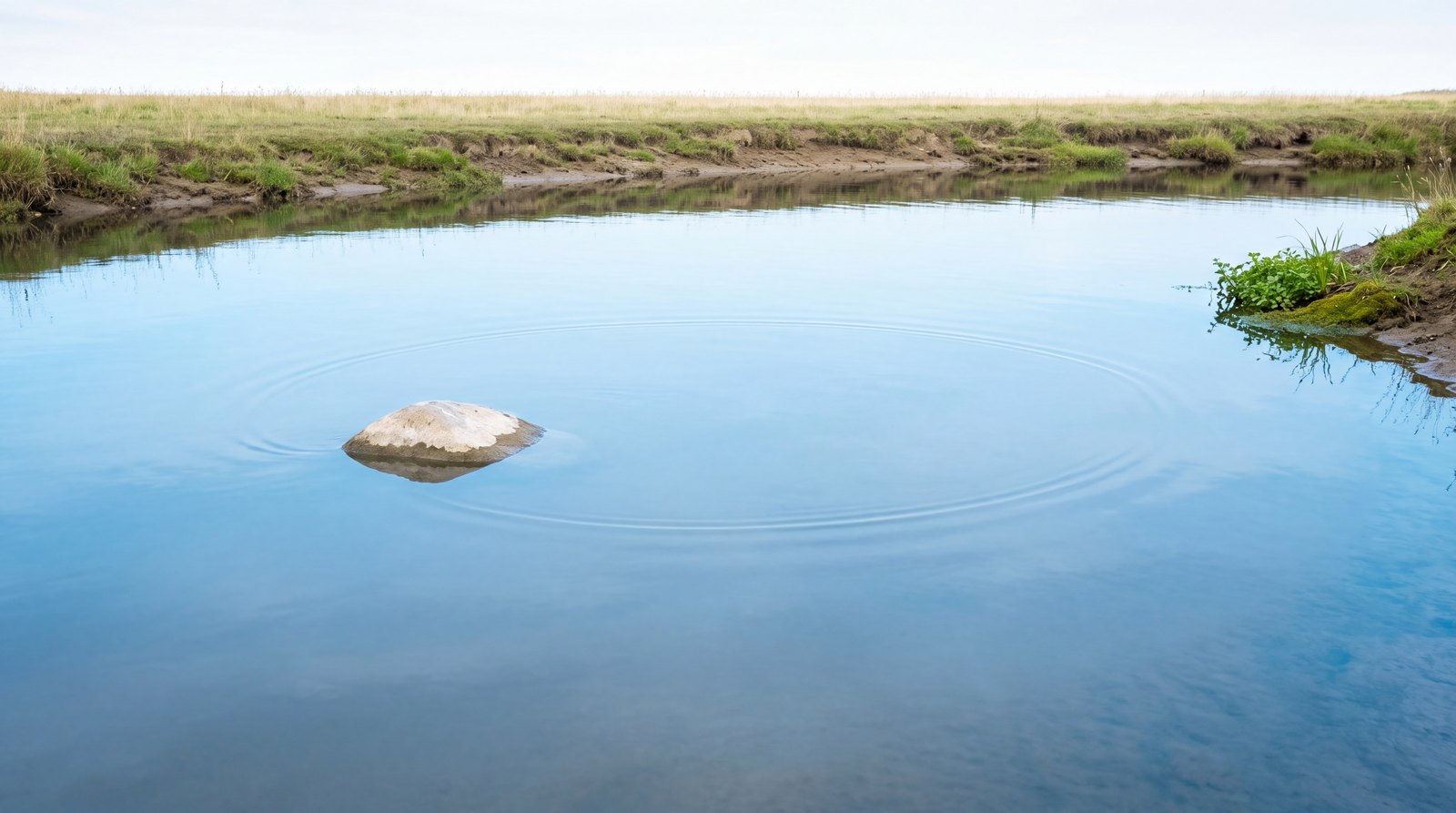
The Water That Already Left
Have you ever stood in moving water and let it register that none of it is coming back? Put a hand in a creek. The water touching your fingers has never touched them before and will never touch them again. It rounds the rock, slides under the bridge, and goes. Meanwhile a person can be cut off in traffic on a Tuesday morning and still be carrying that driver around on Friday afternoon. The water has travelled two hundred miles. The grievance has not moved an inch.
That gap is the whole subject. Here is the claim, plainly, so it can be argued with: the grievance is a separate object from the harm. They arrive at the same instant and we handle them as one thing. They are not one thing, and almost everything changes once you can see the seam between them.
An old collection of verses makes the case better than any modern argument, and makes it as a controlled experiment. Two lines, identical but for a single word. He abused me, he beat me, he defeated me, he robbed me. In those who carry such thoughts, hatred never ceases. In those who do not, it ceases. Read them side by side and notice what the verses refuse to do. They do not soften the injury. The beating stays a beating. The robbery stays a robbery. The only variable permitted to change is the carrying.
There is a story from the same part of the world about two monks walking home. They reach a muddy crossing where a woman is stranded, and the elder picks her up, carries her over, sets her down, walks on. Hours later the younger one cannot contain it and bursts out that monks are not supposed to touch women. The elder answers that he put her down at the crossing, and asks whether his companion is still carrying her. Thirty seconds of actual carrying. Five hours of the other kind. Only one of the two men got tired.
Now something measured, arriving at the same doorway from the opposite road. Researchers studying how time is experienced put the psychological present at roughly three seconds. That is the longest stretch the mind holds together as one unit, one moment, before it has to be filed away as memory. Three seconds is not a tidy number somebody chose. It is the width of now.
Which reframes the pause you take before answering an insult. It is not politeness, and it is certainly not weakness. It is the length of time a moment needs in order to finish being a moment. Answer inside it and you are reacting to something still happening. Wait it out and you are responding to something already downstream, around the rock, under the bridge, gone.
The body keeps its own version of this schedule. The chemical surge that arrives with a jolt of anger runs its course in something like ninety seconds to two minutes. After that the chemistry has finished its work, and whatever continues is being supplied by you. What you do next decides which of four things gets built. A spike, which passes. A mood, which colours a day. A temperament, which colours a season. Or finally a trait, which is the stage at which other people begin describing you with a word you did not choose. Bitter. Resentful. Angry. Nobody wakes up and elects to become that. It accrues in ninety second instalments, from moments that ended long before the carrying did.
Now the strongest objection, put the way somebody who meant it would put it. Some things should not be released. There are injuries where letting go looks a great deal like letting someone off, and the instruction to breathe and move on has been used as a weapon often enough that flinching at it shows good judgement rather than poor. That objection is correct and it has earned the floor.
So take the distinction that answers it, because it is real and it costs nothing to hold. Release is not absolution. You are not required to declare the other driver innocent in order to stop driving around with him in your passenger seat. You are not required to call the thing fair, or fine, or finished. Setting down the weight adjudicates nothing about whose fault it was that you had to lift it. A verdict may take years and may never arrive. What you are willing to carry while you wait is a separate decision, available today.
Named plainly, because it should be named before anyone has to ask: who this does not serve. If you are inside something ongoing rather than something over, this is the wrong tool, because the pause that protects you from a stranger in traffic will not protect you from a situation you need to leave. Discernment first, equanimity afterward. If the injury is fresh and large, an instruction to release it will land as an insult, and it should, because grief runs on its own clock and nobody else may set it. And if this is being used to vault over an anger you have not yet allowed yourself to feel, nothing is being released. It is being stored somewhere less convenient.
So, back to the creek. Everything in it is already leaving. The driver who cut you off this morning has no idea you exist, will not remember the intersection by tonight, and in three years neither will you. That moment survives in exactly one way, which is if you agree to be the one who keeps it alive. Three seconds is what it costs to let it go past. Two car lengths is what makes that safe. Both are gifts, and neither one is for them.
What are you still carrying that put itself down a long time ago? If you would rather work that out in company than alone, come and find the others. The door is open, and the water keeps moving whether or not we discuss it.