What the Table Knew Before the Lab Did
Have you ever noticed that the same table can hold two completely different meals?
Picture it. Same room, same chairs, same food. On one night everyone came in tired, and the talk stayed thin and polite. On another the windows were open, nobody was in a hurry, and something moved around that table that was not there the first time. We file that under mood and move on. I want to hand you an older explanation, because people were working on this long before any of us sat down to eat.
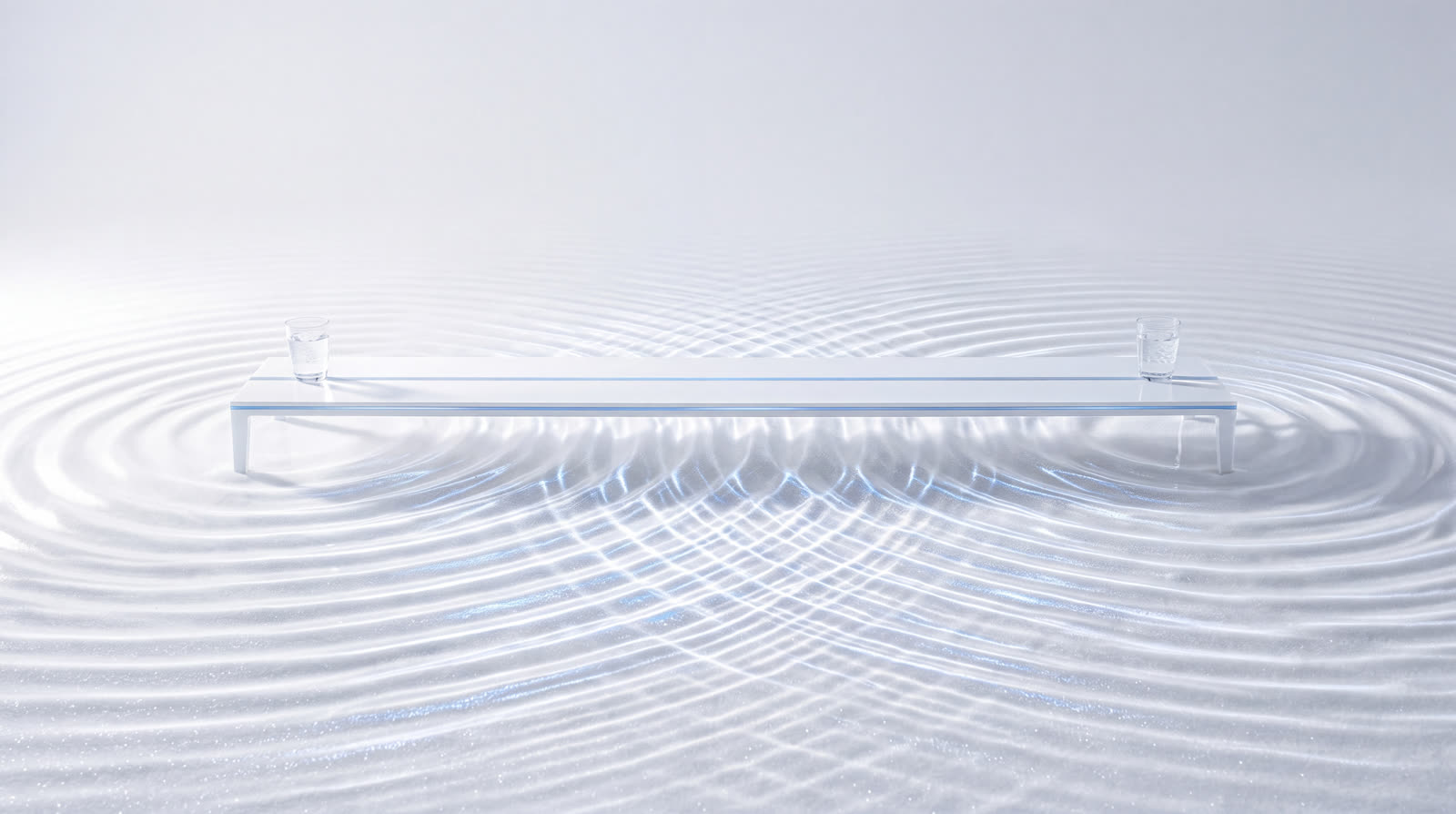
Here is the frame. Your body is not the box your awareness got locked inside. It is the instrument your awareness gets played on. An instrument out of tune does not only sound worse. It receives less. A slack string cannot ring in sympathy when another string is struck across the room. That sympathetic ringing is what happens in any room where two strings share a pitch, and it is the clearest picture I know of what passes between two people who are both settled.
So what does tuning actually mean on an ordinary Tuesday? Nothing impressive. How you breathe. Whether you slept. Whether you ate like a person or refueled like a machine. Whether your day carries any rhythm at all. Each of those is a tension setting on the instrument. Change one, and the room you walk into afterward is different, not because the room changed, but because what you can pick up in it changed.
Now let me set two things beside each other on one point, because I have come to believe they are a single instruction in two languages. An old contemplative tradition told its students to lengthen and slow the breath before prayer, on the reasoning that a hurried body cannot hold steady attention, and a scattered attention cannot receive anything larger than itself. Centuries later, laboratory research put ordinary people on monitors and measured what happens when the breath is deliberately slowed to roughly six cycles a minute. The heart rhythm stops wobbling and organizes. The nervous system tips out of its defensive setting. Same point, reached twice. One party got there by sitting still for a lifetime. The other got there with sensors and a spreadsheet. Which of them found it first, and does it honestly matter?
Before you decide whether that is true, do something with it. Here is the smallest version I know, and it belongs at a table. Once a day, aloud, say one sentence to the people you eat with. Not a performance. One true sentence about your day, spoken slowly enough that you hear your own voice arrive at the end of it. Do that daily for one week. You are not trying to feel anything in particular. You are testing whether a sentence said at a slower tempo than your day was running changes what you can hear in the person across from you.
Now the honest objection, at full strength. Someone at this table says: all you have described is physiology. Slow breathing calms the body, calm bodies converse better, and dressing that up in the language of instruments adds nothing but a feeling of significance. That is well made, and followed strictly it makes the whole frame decoration. I would ask only this in return: if the mechanism is real, why would naming it accurately count as decoration? The claim was never that biology is secondary. It is that biology is the tuning, and what a tuned instrument then receives is the question neither of us has closed.
Here is the part I will not soften. This does not work for everyone, and pretending otherwise is how good practices reach the wrong people. If you are in acute grief, in an untreated illness, in a body carrying real trauma, or in a house where speaking honestly at the table is unsafe, a slower breath and a spoken sentence are not your medicine. Tuning assumes an instrument that is basically intact. If yours is cracked, the work is repair, and repair usually needs other hands. That is not a lesser path. It is the correct order.
And there is a seam I refuse to paper over, because I have watched teachers cover it. The traditions do not agree about the body. Some ascetic lineages treated it as the obstacle, a weight to be stilled, starved and eventually left behind, with the real life happening elsewhere. Others treated it as the sanctuary itself, to be fed and honored and never fled. Those are not two phrasings of one idea, and every reconciliation I have heard quietly flattens one of them. I keep both on the table, and I tell you plainly that I do not know which is right. What they agree on is narrower, and here it is enough: whatever the body finally is, how you keep it changes what reaches you through it.
So, what you came for. Your body is the instrument, not the cell. Tuning is unglamorous and lives almost entirely in breath, sleep, food and rhythm. Every lineage that took the body seriously handed down a version of that one instruction in its own tongue, and even the lineages that contradict each other agree on that much. The inheritance is not a belief you have to sign. It is a practice you can carry to any table, for the rest of your life.
So what would change at your table if the instrument were tuned before the meal instead of after the argument? That is a question worth a week, and it is a better question in company than alone. If you want to learn it properly, with the old sources laid open and the seams left showing, come and take the course with us. We will keep a chair at the table for you.