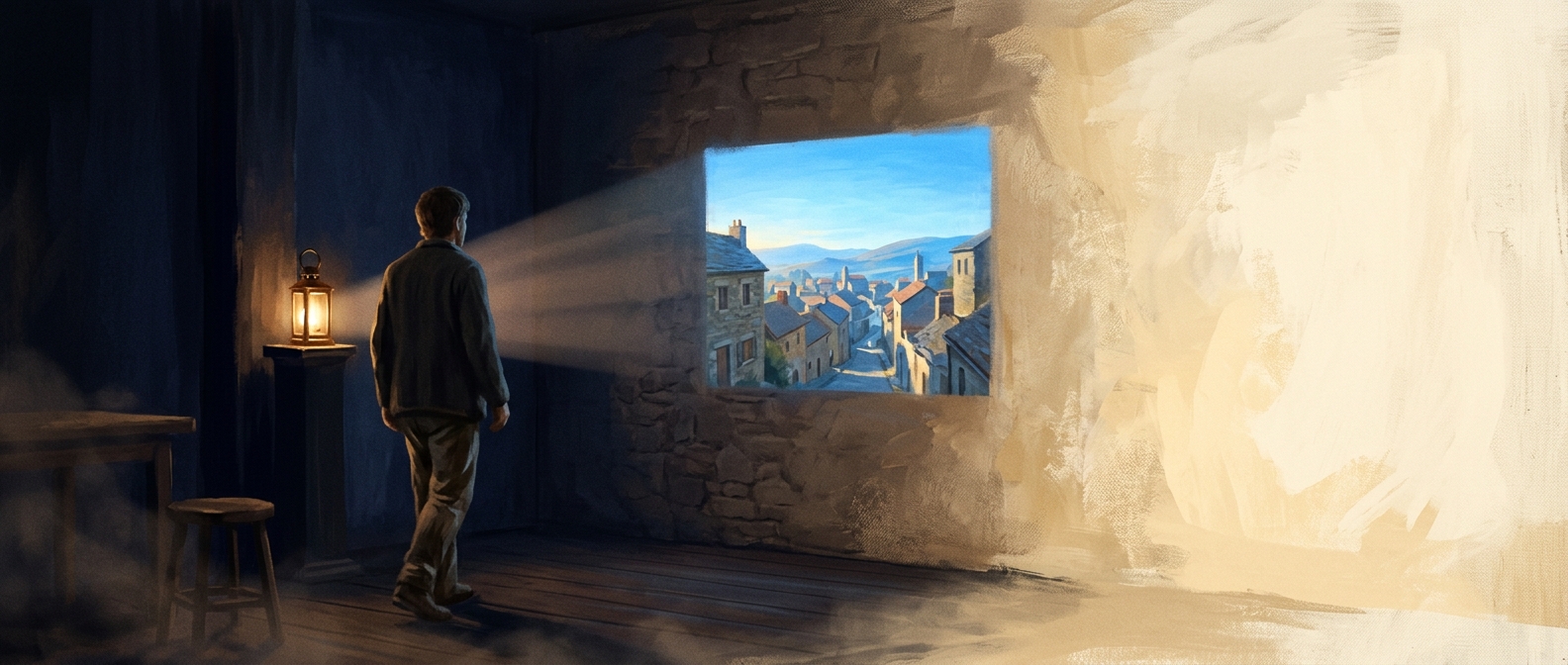
You Have Never Seen Reality. You See Your Filter.
You have never seen reality. Not once. What you have seen, every day of your life, is your filter: a running interpretation assembled by a nervous system that decides, before you get a vote, what is worth your attention and what never reaches you at all. This is not a mystical claim. It is one of the most repeatable findings in sensory neuroscience, and, in a pattern that should make any honest observer sit up, it is also one of the oldest claims in the contemplative record. The traditions and the instruments keep arriving at the same door from opposite roads.
The Numbers Nobody Sits With
Neuroscientists estimate that your senses stream millions of bits of information every second: the pressure of your clothes, the hum of the refrigerator, ten thousand shifts of light and shadow, the position of every joint in your body. Conscious attention, by the same estimates, holds a few dozen bits at a time. Whatever the precise figures, and researchers debate them, the ratio is not close. Nearly everything arriving at your senses is filtered out before you ever meet it.
Sit with that ratio for a moment. It means the world you experience is not the world. It is a summary of the world, prepared for you by an editor you never hired, working from editorial guidelines you did not write. The interesting question is not whether this is happening. The interesting question is who trained the editor.
Meet the Doorman: Sensory Gating
The mechanism has a name. Sensory gating is the process by which your brain, with the thalamus standing at the door, dampens redundant and irrelevant signals so the cortex is not overwhelmed. Without it, the flood of raw input would make coherent experience impossible. People whose gating runs unusually open often describe ordinary rooms as deafening.
Notice what the doorman is selecting for. Not what is real. What is relevant. And relevance is learned: from repetition, from emotional charge, from what mattered to you and to the people who raised you, from every year you have already lived. A city dweller stops hearing traffic. A new parent hears the smallest cry through walls and running water. The signal did not change. The doorman's instructions did.
The Filter Does Not Show You the World. It Shows You Your Expectations.
One layer up from the doorman, psychology gives the guidelines a name: schemas. A schema is a template, built from past experience, that decides what a situation is before you have consciously examined it. Schemas are why two people can attend the same meeting and walk out of two different meetings. Each filter selected the evidence that matched its expectations, and each person experienced their selection as simply what happened.
This is the quiet, verifiable version of a claim that sounds radical until you watch it operate in your own week: perception is expectation-shaped. The filter does not passively transmit. It actively composes, and it composes in your prior image of the world.
Same Filter, Same Life
Here is where the pattern turns personal. Joe Dispenza puts the observation plainly in You Are the Placebo: look at your life from the same level of mind every day, and you cause the same patterns to collapse into place, day in and day out. Those patterns, which you call your life, never change, and so they never allow you to effect change.
Strip the quantum framing if you like; the phenomenology stands on its own. If your filter selects the same evidence every morning, you will live in the same world every evening. The relationship that always disappoints, the opportunity that never appears, the same class of problem finding you in role after role: before these are facts about the world, they are habits of selection. The repeat is not fate. It is a setting.
The Ancients Named It First
What makes this more than a neuroscience curiosity is the convergence. Vedanta named the constructed character of experience thousands of years ago: maya, often translated as illusion, though the tradition is more precise than that. Maya is the creative power through which undifferentiated consciousness appears as a world of separate forms. Not a lie, a rendering. The Gnostics reached for a darker image: a veil drawn between the human being and the real, woven from ignorance and inherited assumption. And in our own era, cognitive scientist Donald Hoffman's interface theory argues from evolutionary mathematics that perception evolved to show us fitness, not truth: a species-specific desktop, useful icons, not the machinery itself.
Three eras, three vocabularies, one recognition: what you take as direct contact with reality is a constructed interface. None of these traditions proves the others. That is not the point. The point is the pattern: independent investigations, separated by continents and millennia, using methods as different as meditation and evolutionary game theory, keep describing the same architecture. When that happens, the pattern itself is the finding.
The Filter Is Adjustable. Attention Is the Dial.
Everything above would be merely humbling if the filter were fixed. It is not. The same research tradition that mapped sensory gating also mapped its plasticity: what you attend to, deliberately and repeatedly, retrains what the doorman lets through. Attention is not just a spotlight. It is a training signal. Every time you hold your attention somewhere on purpose, you are telling the filter, this counts, notice more of this.
This is why the contemplative traditions, which recognized the veil, immediately built practices for working with it. The Gnostic initiate and the meditator were not decorating their philosophy; they were training the gate: creating enough inner silence that subtler signal could pass the door that habit had been slamming shut. Modern attention practice is the same discipline in plainer clothes. It is not positive thinking. Positive thinking argues with the filter's output. Gatekeeper training changes the filter's instructions.
The practice is unglamorous and it works: choose, on purpose, what you rehearse noticing. Attend daily to evidence your current filter discards, and the filter widens. Look from a different level of mind, and different patterns collapse into place. Nothing about this requires belief. It requires repetition.
Who Curates Yours?
You will run a filter either way. That part is not optional; a nervous system without gating cannot function. The only live question is whether the filter keeps running on inherited settings, trained by accident, by culture, by whatever mattered to you at seven years old, or whether you take up the training yourself.
This is the ground floor of everything we explore in the Journal: if experience is an interface, then the deliberate cultivation of attention is not self-help at the margins of life. It is editorial control of the only world you will ever inhabit. Begin by watching your own doorman for one day. Notice what gets waved through: which worries, which faces, which evidence. Then ask the only question this essay was built to leave with you: what has your filter been hiding from you?
FAQ: Perception, Filters, and the Veil
Q: Is "you never see reality" a scientific claim or a spiritual one? A: Both, independently. Sensory gating and schema research are standard neuroscience and psychology; maya and the veil are contemplative descriptions arrived at through first-person investigation. Neither certifies the other. Their convergence is the interesting fact.
Q: If everyone's filter is different, is all perception equally distorted? A: Every filter selects, but filters can be trained toward wider, quieter, more accurate reception. That is the entire premise of attention practice: not escaping the interface, but improving its editorial policy.
Q: How is attention training different from positive thinking? A: Positive thinking argues with the filter's output after it is rendered. Attention training changes what gets selected upstream. One is commentary; the other is curriculum.
Q: What is one practical first step? A: Pick one day. Note, each hour, what your attention was given to without your consent: which sounds, worries, and stories got through the door. Awareness of the filter is the first adjustment of the filter.
Q: Where does this idea lead next? A: If perception is an interface, the deeper question is who or what is doing the perceiving. That is the territory of the companion essay, "Consciousness as the Ground of Reality," on the Journal.